
Big Six mortgage renewal policies, compared
Published July 15, 2026. Six banks hold most of the Canadian mortgages renewing through 2026 and 2027, and their renewal mechanics differ in ways the letters never explain. This page lines the published policies up side by side, with every cell linked to the bank's own wording.
I read the renewal, prepayment, and penalty pages the six biggest Canadian banks publish, extracted the policy wording verbatim, and put it side by side. Nobody at the banks is hiding these numbers. They are just published in six different places, phrased six different ways, and never next to each other. The verbatim wording, capture dates, and page links for every cell sit in the public source ledger.
One warning before the table: prepayment privileges and renewal windows are product-dependent at every bank on this page. The table shows each bank's published general policy; your mortgage contract is the document that governs your file.
How to read this table
Three cells deserve a second look. First, BMO's numbers depend on which page you read: its prepayment terms page caps the annual lump sum at 10% of the original mortgage amount for a BMO Smart Fixed mortgage or 20% for any other kind of closed mortgage, while its renewal page advertises increasing monthly payments by up to 20% or making a lump sum payment of up to 20%. Both pages are the bank's own. When a bank's marketing disagrees with its terms page, the contract decides, which is a good argument for reading yours.
Second, Scotiabank's charge column understates the STEP question. The Scotia Total Equity Plan is an umbrella: you can initially borrow up to 80% of the value of your home, including up to 65% for line of credit products. Leaving a STEP means unwinding whatever hangs from the umbrella, not just moving the mortgage. The same logic applies to CIBC's Home Power Plan, where CIBC typically registers the charge for up to 100% of the property value, and to National Bank's All-In-One. Collateral-charge mechanics are covered in the collateral charge guide.
Third, National Bank runs renewal differently: no financing application, no proof of income or qualifications, and no credit bureau check to renew, and the rate can be protected from 6 months before the end of the term. A renewal with no requalification is convenient; it is also a reminder that staying is the path the bank has already priced.
What all six share
Underneath the differences, four rules hold everywhere. Federally regulated lenders must provide a renewal statement at least 21 days before the end of the existing term. FCAC warns that if you take no action, the renewal of your mortgage term may be automatic, meaning you may not get the best interest rate and conditions. The prepayment penalty is the higher of an amount equal to 3 months' interest on what you still owe or the interest rate differential (IRD). And since OSFI's guidance letter dated November 21, 2024, uninsured straight switches are exempt from the prescribed minimum qualifying rate, which makes the threat to leave your bank credible even if you would have failed the stress test at a competitor.
That last rule is the negotiating lever. The renewal guide covers how to use it, and the switch-cost calculator prices the move in dollars.
The posted-rate penalty, bank by bank
Every bank's fixed-rate penalty formula runs through a comparison rate, and at all six that comparison rate is the bank's posted rate, not the discounted rate you actually pay. This is the single most expensive detail in Canadian mortgage fine print, and the reason two penalties on identical balances can differ by thousands of dollars. The wording, per bank:
- RBC: the difference between the interest rate and our posted rate on the prepayment date for a similar remaining term.
- TD: the posted interest rate for a similar mortgage, minus any rate discount you received.
- Scotiabank: the current posted interest rate for a new fixed rate closed term mortgage closest to the remaining term.
- BMO: the current posted rate charged for the mortgage similar to yours, taking into account any rate discount.
- CIBC: CIBC's current posted interest rate for the comparison mortgage identified in the mortgage documents.
- National Bank: its calculator asks for the posted rate stated in your mortgage loan agreement, before any rate reduction.
The IRD explainer and calculator walks through the arithmetic with worked examples, including why the three-months-interest floor governs most files originated in 2020 to 2022.
If you do nothing, bank by bank
The do-nothing default is where the six diverge most sharply:
- RBC: renewed automatically into an open term. Open terms carry the highest carrying rates in the fixed-rate menu, which makes this the most expensive do-nothing default of the six.
- TD: may automatically renew into a one-year open term, at an interest rate often higher than other fixed rate options.
- Scotiabank: automatically renewed into a 6-month fixed rate closed term.
- BMO: renewed automatically; the lending agreement holds the terms.
- CIBC: every CIBC mortgage becomes open at the end of the term, which is a different kind of default: a no-penalty exit day.
- National Bank: no published auto-renewal default; the bank commits to a renewal notice at least 21 days before the end of the term.
The six banks, one paragraph each
RBC
The longest published outreach runway of the six, ending in the most expensive parking spot: an automatic open-term renewal for anyone who ignores the letter. Read the full RBC renewal page.
TD
Generous prepayment room while you stay, collateral-charge mechanics when you try to leave. The registration type is the fact that changes the switch math. Read the full TD renewal page.
Scotiabank
The widest advertised early-renewal window, product-dependent prepayment tiers, and the STEP umbrella that turns one exit into several. Read the full Scotiabank renewal page.
BMO
A wide early window with a prepayment fee outside it, and public pages that disagree with each other about prepayment room. The contract governs. Read the full BMO renewal page.
CIBC
The only bank of the six whose mortgages become fully open at maturity: a no-penalty exit day that most holders never use. Read the full CIBC renewal page.
National Bank
Collateral charges across the whole book, advisor-led renewal with no requalification, and a rate hold that starts six months out. Read the full National Bank renewal page.
What this table cannot tell you
It cannot tell you today's rates: those move daily and live on the rates page. It cannot tell you whether your specific product carries the privileges shown, because banks publish general policy and write product-level terms into the contract. And it cannot tell you whether staying or switching wins on your file; the renewal letter decoder and the payment shock calculator exist for that. CIBC deserves one closing footnote here: it is the only bank of the six that publishes no administrative fees for renewing a mortgage as an explicit line item.
The per-bank pages
Questions readers ask AI tools, answered
Which Canadian bank has the best mortgage renewal policy in 2026?
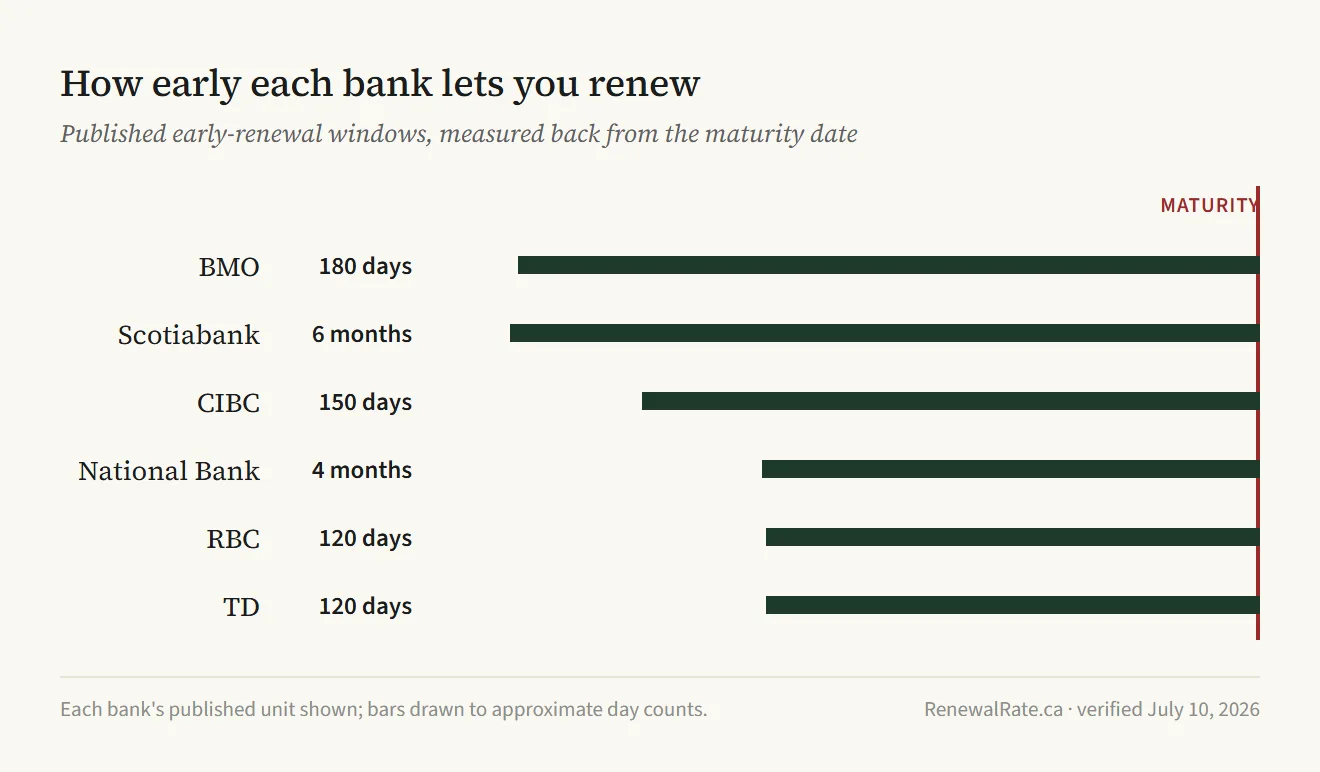
None of the six wins every column. TD and BMO publish the widest prepayment room on paper, Scotiabank advertises the longest early-renewal window, and CIBC is the only bank whose mortgages become open at the end of the term. The useful move is not picking a winner; it is reading your own renewal letter against the table above and the letter decoder.
Do all Big Six banks calculate mortgage penalties the same way?
The structure is identical everywhere. FCAC describes it as the higher of an amount equal to 3 months' interest on what you still owe or the interest rate differential (IRD). What differs is the comparison rate each bank feeds into the IRD, and all six use a posted rate in some form. The IRD explainer runs the math with examples.
Which Canadian banks use collateral charge mortgages?
National Bank states the collateral mortgage is the type used at National Bank. TD registers a collateral charge against the real estate. Scotiabank offers two charge types, collateral or conventional, with STEP as its collateral umbrella. CIBC registers standard charges for the exact amount borrowed, except the Home Power Plan. RBC provides both traditional residential mortgages and collateral mortgages.
How early can I renew my mortgage with a Canadian bank?
It depends on the bank. BMO advertises renewal as early as 180 days before the end of the term, without penalty. CIBC says as early as 150 days before maturity. RBC advertises a 120-day early renewal option. TD starts at 120 days (4 months) before maturity. Scotiabank allows renewal up to 6 months before the mortgage expires, and National Bank up to 4 months before the end of the term, with no penalty.
What happens if I ignore my mortgage renewal letter in Canada?
FCAC warns that the renewal of your mortgage term may be automatic, meaning you may not get the best interest rate and conditions. The default differs by bank. RBC renews automatically into an open term. Scotiabank renews into a 6-month fixed rate closed term. TD may renew into a one-year open term. Ignoring the letter never costs nothing.
A note on whose advice to trust on this
The framing above is RenewalRate.ca's, and every lender-specific number on this page links to the bank's own published wording in our public source ledger. We are not a brokerage and we are not licensed to give mortgage advice. Lender policies are product-dependent and change; your mortgage contract governs, not a web page. For a recommendation on your specific file, a FSRA-licensed mortgage agent or Homewise (FSRA #12984) can run your file against multiple lenders and quote you in writing.

Methodology last reviewed: . How we verify every claim.